Versions
News
What has changed in the edition, version by version, newest first. The edition is an open beta: text, presentation, and tools are being improved continuously.
0.7 Read anew from the print: all fourteen volumes checked November 7, 2026
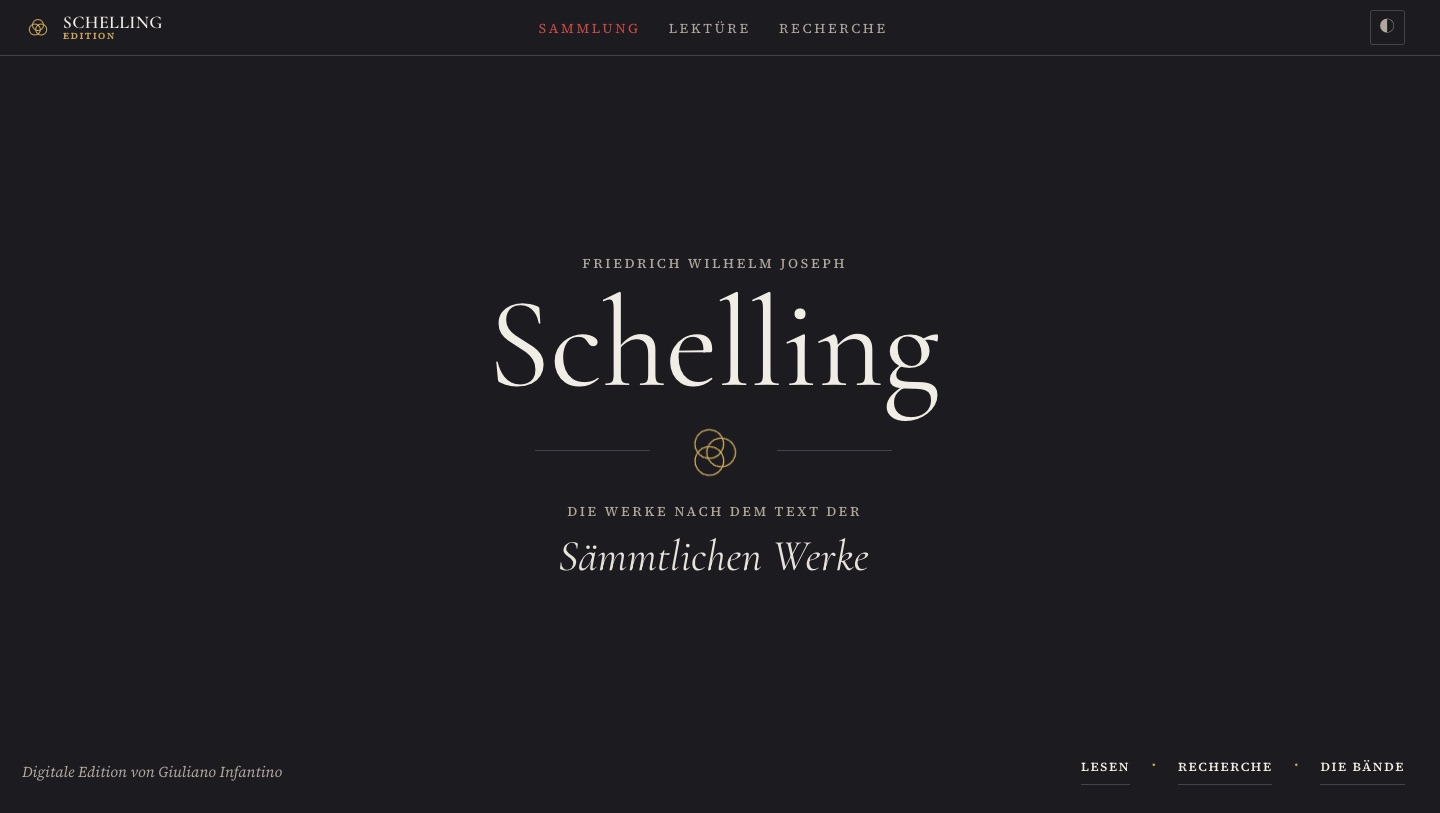 Version 0.7 in pictures →Home page, procedure, accuracy, print layout, contents, and search, with screenshots and the comparison with version 0.30.
Compared with version 0.30
- Every 28th word is different. 82,680 words of the main text now stand as the print has them: “Ich setzte voraus” instead of “setze” (SW I/4, 87), “treten” instead of “terten” (II/4, 122), “Menschengeschlechts” instead of “Menschgeschlechts” (II/1, 98).
- Greek legible. In 0.30 it was garbled in 487 places (“γυμνοί äc καί T ρωτοι”); now 58,350 Greek characters stand in polytonic Unicode (“γυμνοὶ δὲ καὶ ἄστρωτοι”, SW I/1, 19).
- Notes in their place. Instead of one collective block per page, 3,423 individual notes, each linked to its reference in the text.
- More structure. 944 instead of 215 contents entries, 250,747 numbered printed lines, 6,425 marked passages in roman type (Antiqua); 0.30 had none of this.
- All comparisons, passage by passage →
The text
- Recovered anew, page by page. All 7,881 printed pages of the Sämmtliche Werke have been checked against the scan. The text is produced from three readings: an older electronic transcription and the OCR of two copies of the print from the Bavarian State Library. A word is accepted without checking only if neither of the two OCR readings contradicts it and at least one confirms it.
- Decided against the image. Every other passage is decided by machine against the scan of the page, letter by letter, not by sense. Each page is also read through as a whole against the scan; whatever cannot be settled conclusively goes into a second round (Procedure).
- 8,931 improvements over the electronic source text, about one per page: misreadings, silent smoothings, garbled Greek. Genuine misprints of the volume are retained.
- As printed. Greek in polytonic Unicode, letter-spaced type marked, words set in roman type (Antiqua) recognizable, the notes in their place.
Accuracy
- 26 pages read independently. The text of the Freedom essay (SW I/7) agrees with them word for word and line for line: 7,822 words, 712 lines, including letter-spaced type and paragraphs.
- Inserted errors. Of 40 plausible errors inserted into pages as a test, the procedure found 38.
- Two copies. The second OCR reads genuine misprints literally where the first smooths them over. In a test, a weaker OCR would have missed 7 of 43 genuine errors.
- Still open are three pages not yet decided against the scan: SW I/3, 153; I/4, 295; I/10, 197.
Reading and contents
- Print layout with lines. Alongside the reading text, every page appears line for line as in the volume, numbered in the margin; citations give division (Abtheilung), volume, page, and line (SW II/1, 456.12).
- Contents based on the print. 944 entries, aligned with the printed tables of contents and synopses.
- Marginal labels. 388 synopsis items have no heading in the text; the contents jump to the paragraph where they begin, and their title stands there as a marginal label, an addition of this edition. In the contents they appear more quietly than real headings.
- Quotations instead of false headings. 122 verses, mottos, and formulas that the print sets off in the center appear as quotations within the running text.
Search and data
- Full-text search across all fourteen volumes, every passage cited down to the printed line, with the section in which it occurs and the number of hits per volume; one click opens the print layout at exactly that passage.
- TEI for every volume (P5), the same data from which the reader builds its pages; the round-trip test is identical for all volumes. The text is in the public domain; the data are licensed under CC BY 4.0 (Reuse).
0.30 First version May to August 2026
- The fourteen volumes based on an older electronic transcription, 7,762 pages with paragraphs, headings, and notes, not yet checked against the print.
- Contents of the first division (Abtheilung) entered by hand, those of the second taken over from the source text.